
What Is Nike’s Mission Statement?
When your mission is fuzzy, your strategy drifts, and every decision becomes a debate. Nike avoids that. Here’s the exact mission and how I use it.
Nike’s mission is to bring inspiration and innovation to every athlete in the world*, with the note “If you have a body, you are an athlete.”
What Is Nike’s Official Mission Statement?
Nike’s official mission is “To bring inspiration and innovation to every athlete in the world,” and the asterisk points to “If you have a body, you are an athlete.”
I like this mission because it is short, but it is not vague. It gives me three clear anchors: “inspiration,” “innovation,” and “athlete*.” Nike also says these words guide every aspect of its work and have done so for over 50 years, which signals that this line is meant to be stable, not seasonal.
When I try to decode a brand, I look for what the mission protects. Nike’s mission protects two behaviors (inspire + innovate) and one scope choice (every athlete*). That scope choice matters because it sets the brand’s “who.” It says Nike is not only for elite pros. It is also for beginners, kids, and everyday people who still want to feel like athletes in their own lives. That is why this mission stays relevant across sports, cultures, and product categories.
Why Does The Asterisk Matter?
The asterisk matters because it turns “athlete *” from an exclusive label into an inclusive standard that challenges Nike to serve every human being.
Nike’s CEO Elliott Hill literally calls out that he loves the word “athlete*” and explains the asterisk statement: “If you have a body, you are an athlete*.” That one detail changes the mission from a sports mission into a human mission. It also changes how I interpret Nike’s marketing. Nike can tell stories about the world’s best athletes, then still claim it is speaking to me, because it defines me as an athlete too.
I also like how this asterisk creates a practical constraint. If Nike truly serves “every athlete*,” then Nike must balance performance credibility with broad access. That affects sizing ranges, product lines, pricing ladders, and community programs. It also affects what the brand can say out loud. If Nike speaks only to elites, it conflicts with its own definition.
How Do I Break Nike’s Mission Into Three Working Parts?
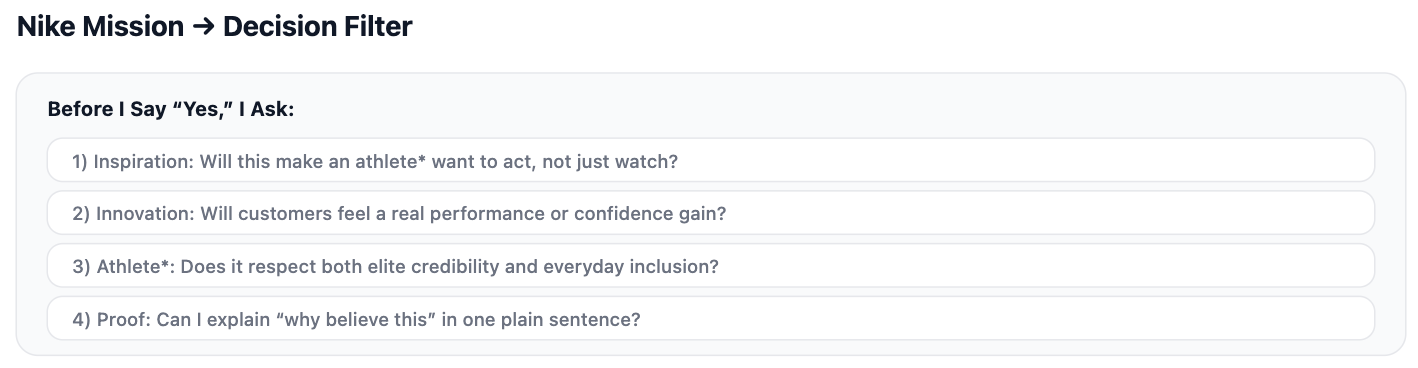
I break Nike’s mission into three parts—Inspiration, Innovation, Athlete—then I turn each part into a simple decision question.
This is how I keep the mission usable in real work, not just “nice words.”
What Does “Inspiration” Mean Here?
“Inspiration” means Nike wants to move people emotionally toward action, not just sell them products.
I interpret “inspiration” as energy and belief. It is the part of the brand that makes people feel capable and seen. I test “inspiration” by asking: does this message make the athlete want to move, train, try, or return? If it only creates hype but does not lead to action, it feels shallow.
When I use this idea on my own projects, I look at real sentiment signals, not guesses. That is also where voicesfromtheblogs.com fits naturally: the VOICES Intelligence Engine is built to decode market signals and consumer sentiment, then translate them into clear strategy outputs. “Inspiration” is a people-signal problem, so I treat it like the People voice: what are people actually feeling, and what makes them take the next step?
What Does “Innovation” Mean Here?
“Innovation” means Nike wants to create new performance and new stories, not just iterate on what already works.
I do not read “innovation” as “new for the sake of new.” I read it as “new that makes athletes better,” whether that is product design, materials, fit, or even how the brand communicates. Elliott Hill links innovation to creating “mind-blowing products and stories,” which tells me Nike sees innovation as both product and narrative.
My test question is basic: does this change performance, comfort, or confidence in a way the athlete* can feel? If the answer is “not really,” it is probably marketing decoration. If the answer is “yes,” then I ask if it is scalable and consistent, because innovation that fails in the real world hurts trust.
What Does “Athlete” Force?
“Athlete” forces Nike to design and communicate for elite athletes and everyday humans at the same time.
This is the hardest part to execute. Serving elite performance can push you toward narrow products and narrow language. Serving “every athlete” pushes you toward wide use cases and wide access. The asterisk is how Nike holds both. It lets the brand stay aspirational while still being inclusive.
My decision question is: who is this really for, and does it still respect the asterisk? If a product or campaign makes everyday customers feel excluded, it weakens the mission. If it makes the brand feel watered down to athletes at the top, it also weakens the mission. The mission asks Nike to do both without breaking either side.
What Are Common Mistakes When People Copy Nike’s Mission?
The most common mistake is copying the words but skipping the discipline behind them.
I see teams borrow “inspiration and innovation” because it sounds strong, but they do not define what those words mean in their business. Then the mission becomes a poster. The fix is simple: write your own tests. For Nike, the tests are implied: inspire action, innovate for real gains, serve every athlete*.
Another mistake is ignoring the asterisk. If you quote the mission without the footnote, you lose the inclusive strategy and the brand logic. The asterisk is not decoration. It is the boundary that makes the mission uniquely Nike.
The last mistake is treating mission as “marketing copy.” Mission is strategy. Nike’s CEO talks about putting athletes at the center and using that to drive the right discussions and decisions. If a mission does not change decisions, it is not functioning.
Conclusion
Nike’s mission is simple: inspire and innovate for every athlete—and the asterisk is the strategy.