
What Is Market Share?
Market growth feels unclear when I cannot tell if I am winning or just getting lucky.
Market share is the percentage of total sales in a defined market that a company captures over a specific time period. I use it to measure competitive position, not just revenue.
I treat market share as “signal,” not ego. It tells me whether my offer is earning preference in the real world.
What Is Market Share?
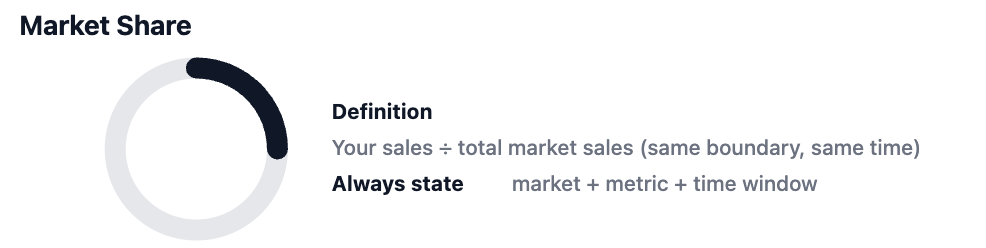
Market share is my slice of a market’s total revenue or unit sales within a clear boundary. The boundary matters more than people think. If I do not define the market, the number becomes a marketing trick. So I always state:
(1) Market definition: category + segment + geography
(2) Metric type: revenue share or unit share
(3) Time window: month, quarter, or year
A simple example: if my company sells $2M in a year, and the total market sells $20M in that same year, my market share is 10%. That sounds clean, but only if the market boundary is honest. “All retail” is useless. “US premium running shoes” is usable.
Why Does Market Share Matter?
Market share matters because it shows whether I am gaining or losing ground against competitors. Revenue can rise while share falls if the market grows faster than I do. Share can rise while revenue stays flat if the market shrinks but I outperform others. That is why I look at share when I want a competitive truth, not just a financial snapshot.
Here is what market share helps me answer:
(1) Am I winning preference, or riding market growth?
(2) Is my positioning working versus alternatives?
(3) Do I have pricing power, or am I discount-dependent?
(4) Which segment is my real stronghold?
(5) Where should I focus next—defend or expand?
This is also where my “voices” habit helps. I often separate: what the Market is doing (category growth, price shifts), what People are choosing (purchase behavior), and what the Strategist should change (positioning, channel, offer). Market share is a clean output that forces that separation.
How Do You Calculate Market Share?
I calculate market share by dividing my sales by the market’s total sales for the same scope and time period. The math is easy. The discipline is in defining the market and getting a reasonable total.
Revenue Market Share Formula
Revenue market share is my revenue divided by total market revenue.
(1) Choose market boundary (example: “US mid-market CRM”)
(2) Get my revenue in that boundary and time window
(3) Estimate total market revenue in the same boundary and time window
(4) Compute: Market share = (My revenue ÷ Total market revenue) × 100
Unit Market Share Formula
Unit market share is my units sold divided by total market units sold.
This is useful when pricing varies a lot. If I sell fewer units but at a premium price, revenue share can look strong while unit share looks weak. Both are valid signals, but they tell different stories.
What Are The Main Types Of Market Share?
The main types are revenue share, unit share, and segment share. I like segment share most because it is actionable.
Revenue Share vs Unit Share
Revenue share tracks dollars; unit share tracks volume. Revenue share is useful for profit and pricing power. Unit share is useful for penetration and adoption. If revenue share rises while unit share falls, I may be moving upmarket or raising price. If unit share rises while revenue share falls, I may be discounting or competing in a lower-priced tier.
Segment Market Share
Segment share measures share inside one specific slice of the market. This is the number that guides strategy. “We have 2% of the total market” is often less useful than “We have 18% in this segment where we win consistently.” Segment share tells me where I should defend and where I should expand next.
What Is A Good Market Share?
A “good” market share depends on market structure, margins, and my business model. I do not chase a generic target like “10%.” In some categories, 2% is amazing because the market is fragmented. In other categories, 2% is weak because one or two players dominate. I judge “good” using these checks:
(1) Profitability: does my share come with healthy margin?
(2) Momentum: is share trending up over time?
(3) Defensibility: is my share tied to a real advantage or just discounts?
(4) Concentration: is the market dominated by a few giants or spread out?
(5) Segment strength: do I own a niche where I can expand outward?
How Can I Increase Market Share?
I increase market share by winning more of the right customers, not by chasing everyone. The fastest paths usually come from improving clarity, distribution, and retention.
Improve Positioning And Proof
I grow share by making the reason to choose me obvious and believable. That means tighter positioning, clearer outcomes, and stronger proof. If buyers cannot explain why I am different, I usually lose to familiarity.
Expand Distribution The Right Way
I grow share by reaching buyers where they already decide. That can mean adding channels, partnerships, marketplaces, affiliates, or a sales motion. I avoid adding channels before my message converts in one channel. Otherwise I scale confusion.
Reduce Churn And Increase Repeat Purchase
I grow share by keeping customers, because retention compounds. If I lose customers fast, I am filling a leaky bucket. Retention improvements often raise market share without any extra ad spend.
Use Pricing And Packaging Carefully
I grow share with pricing and packaging when it matches segment willingness to pay. I prefer bundles, tiers, and outcome-based packaging over constant discounts. Discounts can buy temporary share but damage perception if overused.
What Are Common Market Share Mistakes?
The biggest market share mistakes are using a vague market definition and mixing metrics in a misleading way. I watch for these errors:
(1) Undefined market boundary (makes the share meaningless)
(2) Comparing different time windows (quarter vs year)
(3) Mixing unit and revenue share without stating which one
(4) Using TAM as “total market sales” when TAM was not defined that way
(5) Claiming share without a credible total market estimate
(6) Chasing share at any cost (discounting into unprofitability)
Conclusion
Market share is my portion of total market sales, and it helps me measure real competitive progress.