
What Is Geographic Segmentation?
The same offer can work in one city and flop in another, even when the product is identical.
Geographic segmentation is grouping customers by location so I can adapt messaging, pricing, and distribution to local conditions. I use it when place changes needs, timing, and buying behavior.
I treat geography as a real business variable, not a map decoration.
What Is Geographic Segmentation?
Geographic segmentation is dividing a market into groups based on where customers live or operate. Location affects what people need, what they can afford, how they buy, and what they trust. That is why geography can be one of the most practical segmentation methods, especially for local services, retail, logistics-heavy products, or any business where regulations and culture vary by region.
I define geographic segments using simple layers:
(1) Country / region
(2) State / province
(3) City / metro area
(4) Neighborhood / radius
(5) Urban vs suburban vs rural
(6) Climate zone
(7) Population density
(8) Local regulations and taxes
I do not use all layers at once. I choose the layer that changes the decision. If the customer experience changes by shipping time, I segment by distance and logistics. If the product is seasonal, I segment by climate. If the offer is regulated, I segment by jurisdiction.
Why Does Geographic Segmentation Matter?
Geographic segmentation matters because location changes constraints, competition, and what “value” means. If I ignore geography, I often misread performance. A campaign might look weak, but the real issue is delivery time in one region. A product might churn, but the real issue is seasonal demand. A service might fail, but the real issue is local regulation or local expectations.
I see geographic segmentation help most in:
(1) Targeting and channel selection: some channels work better in certain regions
(2) Pricing and promos: willingness to pay can vary by cost of living
(3) Operations: shipping, support hours, and fulfillment capacity
(4) Seasonality: weather and holidays change timing and demand
(5) Competitive positioning: local competitors can set “default expectations”
This is also where I like the “Three-Voices” way of thinking: the Market voice changes by region (competition and economics), the People voice changes by culture and habits, and the Strategist voice decides what to localize and what to keep consistent.
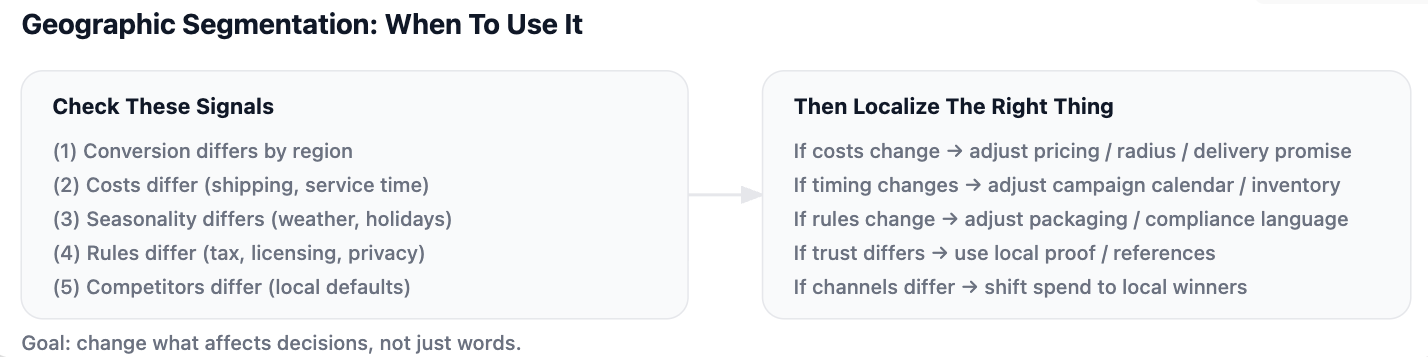
“At this point, I use a simple check: if location changes performance or constraints, I localize the part that drives the decision—not just the words.”
What Are Examples Of Geographic Segmentation?
Examples include tailoring offers by city, adjusting pricing by region, changing messaging by climate, or localizing distribution by distance. I keep examples tied to actions a business can actually take.
Local Services And Radius Targeting
For local services, I segment by radius and neighborhood because travel time changes capacity and margins. A cleaning service, contractor, or clinic often needs tighter geographic boundaries to stay profitable. In that case, segmentation is not marketing—it is operations.
Retail And City-Level Differences
For retail, I segment by city or metro area because competition and income levels differ. A premium brand may perform better in certain metros, while value messaging may perform better in others. The product can stay the same, but the lead message and promo strategy change.
Climate And Seasonal Demand
For seasonal products, I segment by climate zone because timing drives conversion. Winter gear sells earlier in cold regions. AC services spike in heat waves. If I run one national campaign with one schedule, I waste budget.
Regulations And Legal Constraints
For regulated industries, I segment by jurisdiction because the offer may need to change. Even simple differences in taxes, licensing, or data rules can force different packaging and messaging.
Shipping Speed And Logistics
For ecommerce, I segment by distance to fulfillment because delivery speed changes customer expectations. Fast shipping can be a differentiator in one region and impossible in another. If I promise speed everywhere and fail in one region, brand trust drops.
How Do I Choose The Right Geographic Segments?
I choose geographic segments by finding where location changes behavior, costs, or conversion. I do not segment by geography just because I can.
Here is the decision checklist I use:
(1) Does conversion differ by region?
(2) Does churn differ by region?
(3) Does CAC or CPM differ by region?
(4) Do support and delivery constraints differ by region?
(5) Do competitors differ by region?
(6) Does seasonality differ by region?
If at least one of these is true, geography likely matters enough to segment.
How Do I Use Geographic Segmentation In Marketing?
I use geographic segmentation by localizing the parts that change decisions, while keeping the core brand consistent. Localizing everything is expensive and often unnecessary. I focus on a few levers.
Localize The Offer, Not Just The Words
I localize the offer when the local constraint is real. Examples include different delivery promises, different service areas, or different bundles based on climate. Simple copy changes are not enough if the experience is different.
Adjust Proof And Examples
I use local proof because it increases trust. Local reviews, local case studies, and familiar references help. Even mentioning local delivery windows can improve conversion.
Choose The Right Channels By Region
I choose channels based on what works locally. Some regions respond better to search, some to social, some to partnerships. I let performance data guide this.
Keep Measurement Clean
I keep tracking clean so I do not confuse region effects with creative effects. I separate tests by region when possible. Otherwise, one region can dominate results and hide failures elsewhere.
What Are Common Geographic Segmentation Mistakes?
Common mistakes are over-segmenting, stereotyping regions, and localizing messaging without matching operations. I avoid:
(1) too many micro-regions that are hard to manage
(2) assuming culture differences without evidence
(3) promising delivery or service levels that the region cannot support
(4) ignoring local competitors and local price anchors
(5) treating geography as a replacement for behavioral data
Geographic segmentation works best when it reflects reality: costs, timing, and constraints.
Conclusion
Geographic segmentation groups customers by location so I can match offers and messaging to local needs, costs, and timing.