
What Is Customer Segmentation?
Trying to market to “everyone” makes my message feel invisible to the people who should care.
Customer segmentation is the process of grouping customers into smaller sets that share similar needs, behaviors, or traits. I use it to stop guessing, because one offer rarely fits every buyer the same way.
I like segmentation because it turns a messy market into a few clear audiences I can serve on purpose, not by accident.
What Is Customer Segmentation?
Customer segmentation is how I divide a broad market into groups that respond differently to a product, price, or message. The key word is “differently.” If two groups buy for different reasons, they need different language. If two groups have different budgets, they need different packaging. If two groups use the product in different situations, they need different onboarding and proof.
When I do this well, my marketing gets cheaper and my product decisions get cleaner. When I do it poorly, I create random personas that nobody on the team trusts. So I keep segmentation tied to decisions: what will I change if this segment is real?
Here is the simplest rule I follow:
(1) A segment is only useful if it changes what I do.
(2) If it does not change anything, it is not a segment.
Why Does Customer Segmentation Matter?
Customer segmentation matters because it improves targeting, positioning, and pricing by matching the offer to the right people. If I do not segment, I usually end up with generic messaging and weak conversion. I may still get traffic, but I lose the sale because the buyer cannot see themselves in the offer.
Segmentation helps me answer practical questions like:
(1) Who should I focus on first?
(2) What should I promise in one sentence?
(3) What proof does this buyer need to trust me?
(4) What price and package makes sense for this group?
This is also where the voicesfromtheblogs.com way of thinking fits naturally for me. If I listen to “market voices” at scale, I can separate what the Market is doing, what People are actually saying, and what the Strategist should do next. Segmentation is basically that idea applied to customers: separate signals, then choose a better action.
What Are The Main Types Of Customer Segmentation?
The main types are demographic, geographic, psychographic, behavioral, and needs-based segmentation. I do not always use all five. I choose the type that best explains buying decisions in my category.
What Is Demographic Segmentation?
Demographic segmentation groups customers by measurable traits like age, income, job title, or company size. It is easy to use, but it can be shallow. Two customers with the same age can still buy for very different reasons. I use demographics as a starting filter, not the final answer.
What Is Geographic Segmentation?
Geographic segmentation groups customers by location, climate, language, or region-based constraints. I use this when logistics, culture, regulations, or seasonality change the buying decision. It is very real in retail, food, travel, and local services.
What Is Psychographic Segmentation?
Psychographic segmentation groups customers by values, lifestyle, motivations, and attitudes. This helps when emotion and identity drive the purchase. The risk is that it becomes “vibes.” I keep it grounded by tying it to observable behavior, like what content they save, what objections they repeat, or what tradeoffs they accept.
What Is Behavioral Segmentation?
Behavioral segmentation groups customers by what they do: usage, frequency, loyalty, triggers, and buying patterns. This is one of my favorites because it is closer to reality. I can often see it in product analytics, purchase history, and support tickets.
What Is Needs-Based Segmentation?
Needs-based segmentation groups customers by the specific outcome they want and the pain they want to avoid. This is usually the most useful for positioning, because it tells me what to promise and what to prove. It also helps me avoid building features for the loudest users if they are not the best customers.
How Do I Create Customer Segments Step By Step?
I create customer segments by starting with real data, then testing whether the segments predict different outcomes. I keep it simple and repeatable.
Step 1: What Question Am I Trying To Answer?
I start by naming the decision segmentation will improve. For example:
(1) “Which customer should we target first?”
(2) “Why are conversions low?”
(3) “Which feature should we build next?”
(4) “What pricing tier should we add?”
If I cannot name the decision, the segmentation work usually turns into a long document that nobody uses.
Step 2: What Data Should I Use?
I use a mix of qualitative and quantitative data so I do not get fooled by one signal. My go-to inputs are:
(1) interviews and call notes
(2) surveys (especially open-ended answers)
(3) reviews and support tickets
(4) product usage logs and conversion funnels
(5) competitor positioning and pricing pages
I do not need perfect data. I need enough evidence to see repeated patterns.
Step 3: How Do I Form The Segments?
I form segments by clustering customers around shared needs and behaviors, not just labels. I look for repeats like:
(1) the same “job to do”
(2) the same top objection
(3) the same trigger moment (why now)
(4) the same success metric (what “good” means)
(5) the same willingness to pay range
If these repeats show up, I can name a segment in plain English, like “busy teams who need speed” or “cautious buyers who need proof.”
Step 4: How Do I Validate The Segments?
I validate segments by checking if they behave differently in ways that matter. I test for differences in:
(1) conversion rate
(2) sales cycle length
(3) churn and retention
(4) feature adoption
(5) price sensitivity
(6) support burden
If two segments do not behave differently, I merge them. If a segment is too small or too hard to reach, I downgrade it to “interesting” and move on.
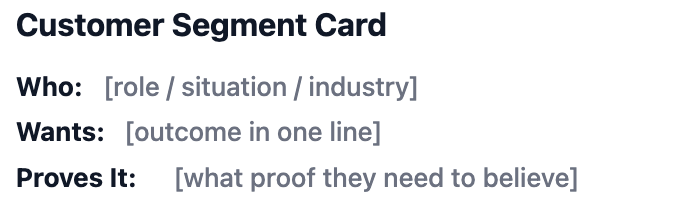
Here is a compact “segment card” I like to keep for each group:
What Are Common Mistakes In Customer Segmentation?
The most common mistakes are segmenting by easy labels, building too many segments, and forgetting to connect segments to actions. I watch for these traps:
(1) Segments that are just demographics (no behavior or need difference)
(2) Too many segments too early (the team cannot execute on them)
(3) No “so what” (no change to offer, message, channel, or product)
(4) Confusing loud users with best users (support volume ≠ profit)
(5) Never updating segments (markets shift, so segments drift)
When I keep segmentation tied to outcomes, it stays alive and useful.
Transition
Once I can name 2–4 real segments, my marketing and product work feels less foggy. I stop trying to convince everyone, and I start matching the right message to the right buyer.
Conclusion
Customer segmentation groups buyers so I can target, position, and price with clarity.