
What Is Customer Profiling?
I can have a good product and still waste money, because I am talking to the wrong “kind” of buyer.
Customer profiling is the process of creating a clear description of my ideal customer based on real traits, needs, and behaviors. I use it to focus my marketing, product decisions, and sales effort on people who are most likely to buy and stay.
I do not treat a customer profile like a creative writing exercise. I treat it like a decision tool.
What Is Customer Profiling?
Customer profiling is building a practical “picture” of the customer I want to win, using facts and patterns from data. A profile can describe an individual buyer (B2C) or an ideal company account (B2B). The point is not to describe everyone who could buy. The point is to describe the customer who is the best fit—meaning they have a real need, they value the outcome, and they are likely to convert and retain.
I keep customer profiling in three layers, because that keeps it usable:
(1) Who they are: role, industry, company size, life stage, location
(2) What they need: pain points, desired outcomes, success definition
(3) How they behave: triggers, objections, buying process, usage patterns
If one layer is missing, the profile becomes weak. A profile with only “who they are” becomes demographic fluff. A profile with only “needs” becomes too broad. A profile with only “behavior” can miss context and motivation.
Why Does Customer Profiling Matter?
Customer profiling matters because it improves targeting, messaging, and product focus by reducing guesswork. When I have a clear profile, I stop trying to convince people who will never be happy customers. That saves time and money.
Here is what usually improves when the profile is real:
(1) Ad performance: better click-through and conversion because the message fits
(2) Sales efficiency: fewer “bad-fit” calls, faster qualification
(3) Retention: the product matches the customer’s real workflow
(4) Pricing power: the offer feels “worth it” to the right buyers
(5) Content clarity: topics match what the ideal customer actually searches for
This also fits naturally with how I like to think on voicesfromtheblogs.com: I listen to market signals, I study what people actually say and do, and then I choose a strategy that matches reality. Customer profiling is basically that workflow applied to a specific buyer group.
What Is The Difference Between Customer Profiling And Customer Segmentation?
Customer profiling describes one ideal customer type; customer segmentation splits the full market into multiple groups. I keep it simple:
(1) Segmentation: “We have 3–5 groups in this market.”
(2) Profiling: “This is the one group we want to win first, in detail.”
In practice, I often segment first, then create a profile for the segment I choose to focus on.
What Should A Customer Profile Include?
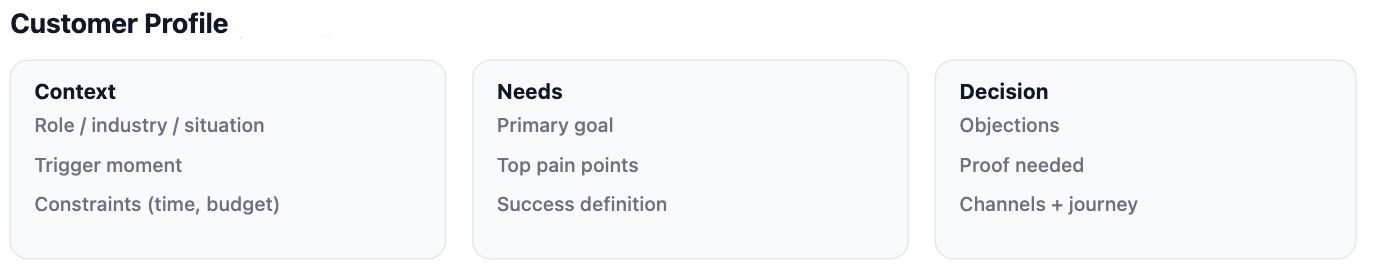
A useful customer profile includes traits, goals, triggers, objections, and decision behavior. I keep the profile short enough to use, but complete enough to guide action.
Customer Profile Elements I Use
These elements are the ones I see teams actually reuse:
(1) Profile name: a simple label the team understands
(2) Context: role, industry, situation, or life stage
(3) Primary goal: what they want to achieve
(4) Top pain points: what makes the goal hard
(5) Trigger moment: what makes them act now
(6) Key objections: what makes them hesitate
(7) Decision criteria: what they compare and what proof they need
(8) Buying journey: how they decide (fast, cautious, committee)
(9) Success metric: what “good” looks like after purchase
(10) Channels: where they discover and trust information
If I can’t connect the profile to a real message and offer, I know it is still vague.
Here is a simple profile card format I like:
How Do I Create A Customer Profile Step By Step?
I create a customer profile by pulling patterns from real customers, then validating the profile with outcomes. I do not start with assumptions.
Step 1: Start With Real Customer Evidence
I start with customer evidence like calls, surveys, reviews, and usage patterns. I collect:
(1) why they bought
(2) what almost stopped them
(3) what they compared me to
(4) what success looks like after purchase
(5) what made them stay or leave
I keep the language in the customer’s words. That prevents “marketing fiction.”
Step 2: Look For Patterns That Predict Good Customers
I look for patterns that predict high retention, high satisfaction, or high willingness to pay. The “best” customer profile is not the loudest customer. It is the customer who gets value reliably. I compare good customers vs churned customers and ask what differs.
Step 3: Write The Profile In Plain English
I write the profile so a teammate can recognize the customer in 10 seconds. If the profile is too long, it gets ignored. I keep it simple and specific.
Step 4: Validate With Tests
I validate the profile by testing messaging and offers against it. If the profile is correct, I see:
(1) higher conversion when the message matches
(2) lower support burden because expectations fit
(3) better retention because the workflow fits
If I do not see these changes, I refine the profile.
What Are Common Mistakes In Customer Profiling?
Common mistakes are writing fictional profiles, copying competitor personas, and ignoring behavior. I avoid:
(1) profiles built only from opinions
(2) profiles that describe “everyone”
(3) profiles with no trigger moment or decision criteria
(4) profiles that never get updated
(5) profiles that do not connect to any real action
If the profile cannot guide a landing page, an ad, or a sales script, it is not finished.
Conclusion
Customer profiling defines my ideal buyer so I can target, message, and build with less waste.