
What Is A Brand Audit?
My brand can look consistent, yet growth feels stuck, because the market is reading me differently than I expect.
A brand audit is a structured review of how a brand is performing and how it is perceived across key touchpoints. I use it to find gaps between what I want to communicate and what customers actually believe.
I treat a brand audit like cleaning a lens. The goal is not “more branding.” The goal is sharper signals.
What Is A Brand Audit?
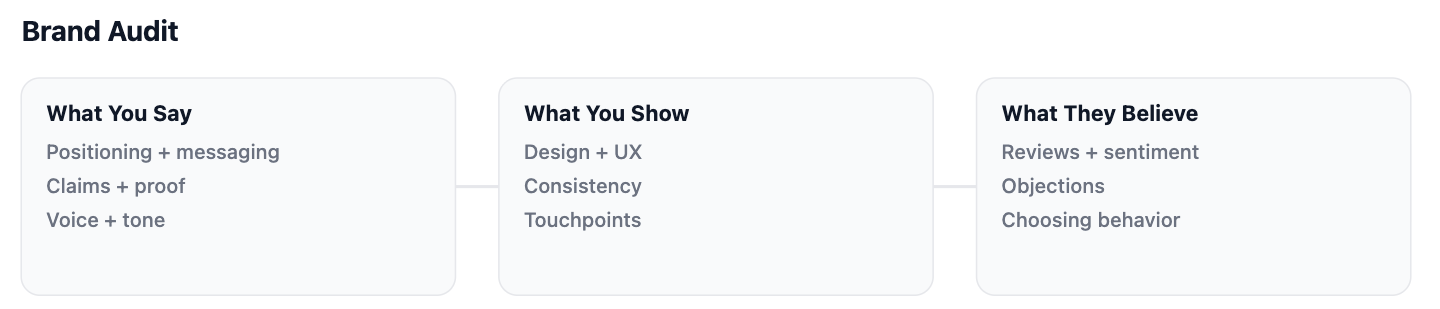
A brand audit is a systematic check of brand identity, brand messaging, customer perception, and real-world performance. It is not just reviewing a logo or colors. It looks at what the brand says, what the brand shows, and what the market hears. I like audits because they force reality. A team can feel confident internally, while customers remain confused or indifferent. An audit pulls the evidence together: website pages, ads, emails, reviews, social content, sales materials, and customer feedback. Then I can answer a practical question: “Is the brand doing its job?”
I usually define “brand doing its job” as:
(1) customers understand what we do fast
(2) customers trust the promise
(3) customers see a reason to choose us
(4) the experience matches the message
When one of these breaks, conversion and retention suffer.
Why Does A Brand Audit Matter?
A brand audit matters because it shows where brand leaks are costing me money. When the brand is unclear, every channel becomes more expensive. Ads need more spend to get the same conversion. Sales needs more calls to close. Support gets more basic questions. The product team gets pulled into “messaging fixes” instead of building. I have also seen the opposite: a product that is objectively good, but looks untrustworthy because proof is missing or the website feels inconsistent. A brand audit surfaces those leaks.
Here is what a brand audit helps me improve:
(1) Clarity: people understand the offer in seconds
(2) Trust: claims are backed by proof and consistent experience
(3) Differentiation: buyers see why this brand is not interchangeable
(4) Efficiency: campaigns and content perform with less waste
(5) Alignment: teams stop using five different stories
This fits naturally with the theme of voicesfromtheblogs.com. The whole point is decoding signals—what the market says, what customers say, and what the business should do next. A brand audit is the same idea, applied to my own brand’s signals.
What Does A Brand Audit Include?
A brand audit includes internal brand clarity, external perception research, competitive review, and touchpoint consistency checks. I keep it structured so it leads to actions, not just notes.
Internal Brand Clarity
Internal clarity checks whether the team can explain the brand the same way. I look for misalignment in:
(1) value proposition
(2) target customer
(3) main use case
(4) top differentiators
(5) proof and case examples
If different teams tell different stories, the market receives a blended, confusing message.
External Brand Perception
External perception checks what customers and the market actually believe. I use:
(1) reviews and testimonials
(2) customer interviews
(3) survey questions like “why did you choose us?”
(4) support tickets and objections
(5) social comments and community discussions
I pay attention to repeated language. Repeats are signal. One-off comments are noise.
Competitive Positioning Review
Competitive review checks how buyers compare me to alternatives. I look at:
(1) category frame competitors use
(2) claims competitors lead with
(3) proof competitors show
(4) pricing and packaging patterns
(5) where competitors feel “safer” or “simpler” than me
This helps me decide where to fight and where to avoid direct comparison.
Touchpoint And Consistency Audit
Touchpoint review checks whether the brand feels consistent across real customer journeys. I review:
(1) website pages and landing pages
(2) ads and creatives
(3) email sequences
(4) onboarding and product UI
(5) sales decks and proposals
(6) customer support tone and policy pages
I look for “brand breaks,” where the experience suddenly feels like a different company.
How Do I Do A Brand Audit Step By Step?
I do a brand audit by collecting assets, listening to customer language, comparing competitors, then turning findings into a short action list. I avoid audits that become endless.
Step 1: Define The Goal And Scope
I define what I want the audit to improve: clarity, conversion, trust, or repositioning. Then I choose the scope: whole brand or one product line, one region, or one funnel.
Step 2: Collect Evidence
I collect the key materials and feedback sources. I pull real assets, not “ideal” documents. I want what customers actually see.
Step 3: Evaluate Signals Against A Simple Checklist
I score each touchpoint with a simple checklist. I use questions like:
(1) can a new visitor explain what we do in 10 seconds?
(2) is the target customer obvious?
(3) is there proof for the main claim?
(4) is the next step clear and low-friction?
(5) does this match what reviews say?
Step 4: Identify Gaps And Prioritize Fixes
I turn findings into prioritized actions. I categorize issues:
(1) clarity gaps (confusing message)
(2) trust gaps (missing proof, unclear policies)
(3) consistency gaps (different tone, different promise)
(4) differentiation gaps (sounds like everyone else)
Then I prioritize by impact and effort. I prefer quick wins first, like improving proof and tightening the hero message, before I change visual identity.
Step 5: Re-test After Changes
I re-test the brand after changes to confirm improvement. I watch conversion, time-to-understand in user tests, support questions, and sales objections. If the audit fixes are working, I usually see fewer “basic” questions and faster decisions.
What Are Common Brand Audit Mistakes?
Common mistakes are focusing only on visuals, ignoring customer language, and producing a report without actions. I avoid:
(1) “logo-first” audits that skip messaging and proof
(2) competitor lists without real comparison insights
(3) collecting too much and prioritizing nothing
(4) relying only on internal opinions
(5) not measuring impact after changes
An audit is only valuable if it changes what the business does next.
Conclusion
A brand audit reveals gaps between what I say, what I show, and what customers believe—so I can fix leaks and grow trust.