
Is Tesla American Made?
People want a simple yes. People get a messy supply chain. That gap creates confusion and bad assumptions.
Tesla is often assembled in the United States for U.S.-sold models, but it is not “100% American made” in parts, and “Made in USA” has a strict legal meaning.
I answer this by separating assembly, parts content, and marketing claims.
What Do Most People Mean By “American Made”?
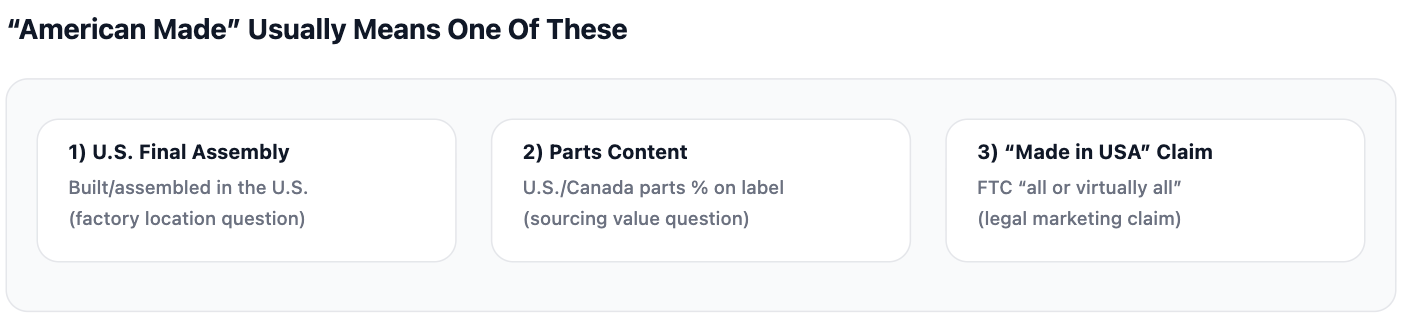
Most people mean one of three things: assembled in the U.S., high North American parts content, or legally “Made in USA.”
I never assume which one a reader means, because each version leads to a different answer. If you mean “final assembly,” then many Teslas for the U.S. market can qualify as American-assembled. If you mean “where the parts come from,” then the answer becomes a percentage game, and the best official shortcut is the AALA label (the window sticker label rule) that reports U.S./Canadian parts content and other origin info. If you mean “Made in USA” as a marketing claim, then the FTC standard is even stricter: an unqualified “Made in USA” claim generally requires the product to be “all or virtually all” made in the U.S.
So I keep it simple: assembly answers “where it was built,” parts content answers “where value comes from,” and FTC rules answer “what you can legally claim.” That separation prevents the most common mistake: people arguing while using different definitions.
Are Teslas Built In The United States?
Yes, Tesla builds several models in the United States, including production at Fremont, California, and at its Texas site in Austin.
I keep this part grounded in Tesla’s own manufacturing pages, because they state what each factory produces. Tesla lists Fremont as producing Model S, Model 3, Model X, and Model Y. Tesla also positions Gigafactory Texas as a U.S. manufacturing hub for Model Y and the home of Cybertruck. That means a Tesla can be “American built” in the plain-language sense if its final assembly point is in the U.S., even if some parts come from outside the U.S.
But I do not stop at factory names, because “built in the U.S.” still does not tell you “how American” the parts are. Modern vehicles are global by default. Batteries, electronics, and subcomponents often cross borders. So I treat U.S. assembly as one layer of the answer. It matters for jobs and local manufacturing. It also matters for some buyer preferences. Still, it does not automatically equal “Made in USA” in the strict claim sense.
How Much Of A Tesla Is U.S. Or Canadian Parts?
Many U.S.-market Teslas show high U.S./Canadian parts content on the required AALA reports, but the percentage varies by model and model year.
When I want a clean, official number, I look at the NHTSA Part 583 AALA reports, because they list U.S./Canadian parts content by carline and model year. For example, the Model Year 2025 AALA alphabetical report includes entries like Tesla Model 3 (some trims shown at 70–75% U.S./Canadian parts content), Model Y (often shown around 70%), and Cybertruck (shown at 65%) along with final assembly and engine/transmission origin fields.
I like this approach because it answers the buyer’s real question: “How much of this car’s value comes from the U.S. and Canada?” It is not perfect, but it is consistent, and it is designed for comparison shopping.
Here’s a quick snapshot style I use (illustrative from the MY2025 report, not a promise for every VIN):
-
Model 3: ~70–75% U.S./Canada parts content
-
Model Y: ~70% U.S./Canada parts content
-
Cybertruck: ~65% U.S./Canada parts content
Can Tesla Call A Car “Made In USA”?
Not automatically—“Made in USA” is a marketing claim with a strict FTC standard that generally requires “all or virtually all” U.S. content.
This is where people talk past each other. A car can be assembled in the U.S. and still fail an unqualified “Made in USA” claim if significant parts content is foreign. The FTC explains that the “Made in USA” labeling rule codifies the “all or virtually all” standard, and it can apply civil penalties for improper unqualified claims. That means companies need to be careful with wording. In real marketing, you often see softer language like “built in America,” “assembled in the USA,” or factory-specific statements, because those claims can be easier to support than “Made in USA.”
So when someone asks me “Is Tesla American made?” I answer in layers: Some Teslas are American-assembled, many show high U.S./Canadian parts content on AALA reporting, but that still is not the same as an FTC-level unqualified ‘Made in USA’ claim.
How Do I Check If My Exact Tesla Is “American Made”?
I check the vehicle’s label info first, because it lists final assembly point and parts content for the carline.
If I’m buying in person, I look at the legally required parts-content label information (AALA label details) and I confirm the final assembly location and the U.S./Canadian parts content percentage. If I’m shopping online, I ask the seller for the window sticker or the relevant label details, because that is faster than guessing from forum threads.
Here is the checklist I actually use:
-
Final assembly point: Is it U.S. or not?
-
U.S./Canada parts content %: High or moderate?
-
Major foreign sources listed (if any): Which countries contribute most?
-
Language used in marketing: “Made in USA” vs “assembled/built” wording
This is also how I would run it through a VOICES-style view: Market (what alternatives offer), People (what buyers mean by “made here”), Strategist (what claim is defensible and clear).
Conclusion
Tesla can be American-built, but it is not “100% American made,” and the best answer depends on assembly, parts content, and claim rules.