
A Beginner’s Plan for Learning New Skills Online
Most beginners start with the wrong question: “Which path is best, a degree, a certificate, or teaching myself?” The better question is “What does each path give me, and in what order do I need it?”
Skills rarely come from one place. They build up in layers, and the people who grow fastest usually learn to stack them.
Layer 1: Teach yourself first
Self-teaching is the cheapest way to find out whether you like something. Before you spend money or commit months, spend two to four weeks with free tutorials, library resources, videos, and small practice projects.
The goal isn’t mastery. You’re testing three things:
- Do you enjoy the work when it gets repetitive?
- Can you keep a routine without anyone checking on you?
- Do you want to go deeper?
Self-teaching’s weakness is that you don’t know what you don’t know. It’s easy to end up with scattered knowledge and gaps you can’t see.
Layer 2: Add structure with certifications
Once you know you’re serious, a certification gives your learning a shape. A good one provides a sequence, a deadline, and a way to prove what you know. That matters because “I taught myself” is hard for an employer to verify, while a credential from a recognized program is easier to read at a glance.
Choose carefully. Look for certifications that employers in your target field actually mention in job listings, and be skeptical of anything that promises a career change in a weekend. A certification proves you learned a body of material, not that you can do the job. That’s where the next layer comes in.
Layer 3: Learn by doing on the job
Nothing replaces working with real deadlines, real colleagues, and real mistakes. Experience teaches what courses can’t: how to handle an unclear request, how to work with a difficult stakeholder, how to fix something that’s broken at 4:55 p.m.
You don’t need to wait for a perfect job title. Volunteer work, freelance projects, internships, or a stretch assignment at your current job all count. Each one turns knowledge into proof that you can apply it.
Layer 4: Consider a degree when the goal is bigger
Some goals do call for a degree: certain professions, leadership tracks, or fields where a bachelor’s is the baseline. A degree offers breadth that shorter routes skip, including writing, critical thinking, research, and exposure to ideas outside your specialty.
The old objection was that a degree meant quitting your life for four years. That has changed. Today there are flexible four-year degree options that let working adults study online while keeping a job and a household running. If you’ve already built skills through the first three layers, you can often pursue a degree with clearer goals and make better use of the coursework. Compare programs on schedule, cost, accreditation, and how well they fit the career you want.
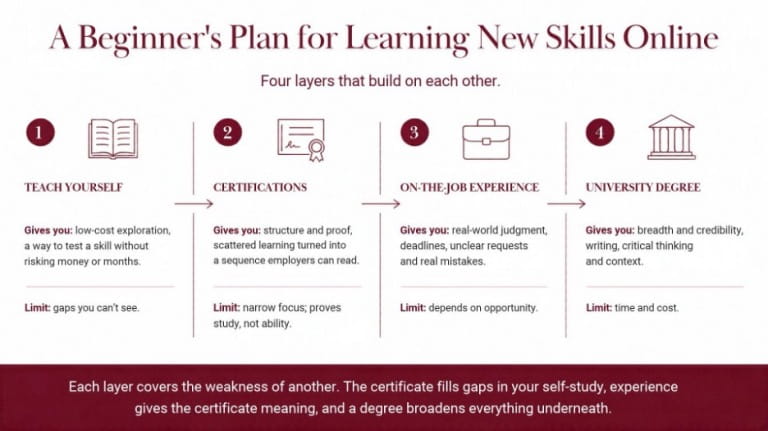
How the layers fit together?
Here’s a simple way to picture it:
A starter plan for the next 90 days
- Weeks 1-2: Pick one skill and try it with free resources.
- Weeks 3-4: Build one small project, even a rough one.
- Month 2: Research certifications or programs and compare them against real job listings.
- Month 3: Find one place to use the skill with real stakes, such as a volunteer task, a freelance gig, or a work project.
- End of month 3: Ask yourself whether your goal needs a bigger step, and if it does, look into flexible four-year degree options that fit your life.
The takeaway
Learning online isn’t one decision. It’s a sequence of small ones, and you can start the first layer today at no cost. Keep what works, add structure when you need it, and bring in a degree when your goals call for it.