
What Is Apple’s Mission Statement?
Big brands look clear from far away, but up close, the “mission” can feel oddly hard to pin down.
Apple’s mission shows up in two official forms: a “best user experience” commitment in filings, and a CEO-stated mission to “enrich lives and empower people.”
I use both lines, but I use them for different jobs.
What Is Apple’s Mission Statement?
Apple expresses its mission in two widely used, official ways, and the “right” one depends on your context.
First, Apple’s SEC filing language (often quoted as a mission) states that the company is committed to bringing “the best user experience” to customers through innovative hardware, software, and services. This is a business-strategy statement, and I like it because it is operational. It tells me what Apple protects: user experience, end-to-end integration, and a tight product-services loop.
Second, Apple’s CEO Tim Cook has stated: “At Apple, our mission is to enrich lives and empower people around the world.” I treat this line as the public-facing “why” layer. It is broader, more human, and easier to connect to impact themes like accessibility, education, and environmental work.
So if I am writing a finance-leaning or strategy-leaning piece, I cite the SEC “best user experience” commitment. If I am writing a brand-meaning or impact-meaning piece, I cite the “enrich lives and empower people” mission quote.
Why Does Apple Have More Than One “Mission” Line?
Apple has more than one mission-style line because different audiences need different levels of specificity and tone.
When Apple writes for regulators and investors, the language needs to be concrete and defensible. That is why the SEC filing statement reads like an operating promise: user experience, innovation, hardware/software/services working together. When Apple speaks in a public story, the language can focus on meaning: enriching lives, empowering people, serving humanity.
I also think Apple’s “values” framing fills in the middle. The ” Relations “Our Values” page talks about business serving the public good, empowering people, and leaving the world better than they found it. This does not read like a single-line mission, but it tells me what kind of company Apple wants to be while chasing “best user experience.” It adds boundaries: privacy, inclusion, environment, and responsibility.
So when someone asks, “What is Apple’s mission statement?” I do not treat it like a trivia question with one correct sentence. I treat it like a signal question: which “voice” are we listening to—market reality, people meaning, or strategist execution? That’s the same idea I use on voicesfromtheblogs.com: decode the signals, then pick the line that matches the job.
How Do I Use Apple’s Mission Statement As A Strategy Checklist?
I use Apple’s mission wording as a checklist that forces tradeoffs, not as a quote I paste into a slide.
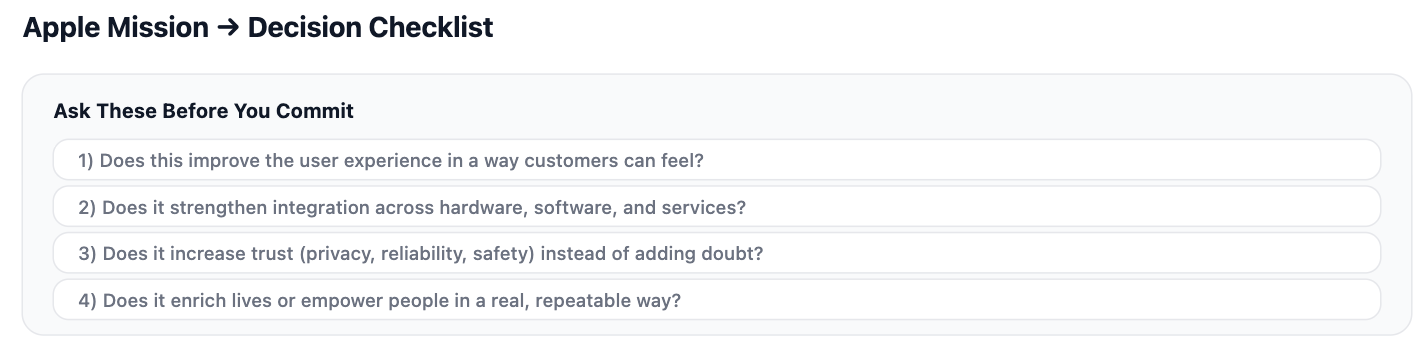
Here is the practical way I do it. I translate the two mission lines into decision tests. Then I run new ideas through them before I get emotionally attached to the idea.
Checklist I actually use:
-
User Experience Test: Does this make the experience meaningfully better, not just “different”?
-
Integration Test: Does this work cleanly with the rest of the system (product + software + services)?
-
Trust Test: Does this increase confidence (privacy, safety, reliability), or does it create doubt?
-
Empowerment Test: Does this help people do more, learn more, create more, or live easier?
-
“Leave It Better” Test: Does this fit the values posture Apple claims (public good / responsibility), or does it fight it?
When I apply this, I do not need to “guess” strategy. I can explain why a feature matters, why a partnership fits, or why a revenue idea feels off-brand. This is where VOICES-style thinking helps: I treat mission as the Strategist voice, then I check the Market voice (competition/alternatives) and People voice (sentiment/trust) before I commit.
What Are Common Mistakes When People Quote Apple’s Mission?
The most common mistake is quoting a mission line without saying where it comes from and what it is used for.
I see people grab a mission statement from random “mission/vision” roundup pages, then repeat it as if Apple published it as a single, official tagline. That creates credibility risk, especially if the reader is picky. A cleaner approach is simple: cite the SEC “best user experience” commitment as a strategy statement, and cite Tim Cook’s “enrich lives and empower people” line as a mission quote.
Another mistake is treating the mission as a “vibes” sentence. Apple’s strategy wording is not vibes. It is a constraint: user experience first, achieved through integrated hardware/software/services. If I claim I follow Apple’s mission, but I ship a confusing experience, or I break trust, then I am not following it. The mission only helps if it changes decisions.
Last, I see people skip the values layer. Apple publicly frames values like serving the public good and leaving the world better. If I ignore that, I misunderstand why Apple invests so hard in privacy messaging, accessibility, and sustainability narratives. Even if I do not copy Apple, understanding the stack (mission-ish purpose + strategy promise + values boundaries) makes the brand easier to decode.
Conclusion
Apple’s mission is best read as two official lines: “best user experience” (execution) and “enrich lives” (purpose).