
What Is McDonald’s Mission Statement?
A business can grow fast, then lose its point, because the “mission” becomes a vague poster.
McDonald’s mission statement is: “Our mission is to make delicious feel-good moments easy for everyone.”
I read that as a simple promise with strict standards: taste, emotion, convenience, and scale.
What Is McDonald’s Mission Statement?
McDonald’s mission statement is “to make delicious feel-good moments easy for everyone.”
That one sentence does more work than it looks like. It packs four commitments into everyday words, which is exactly why it is usable. I can repeat it, and I can test decisions against it.
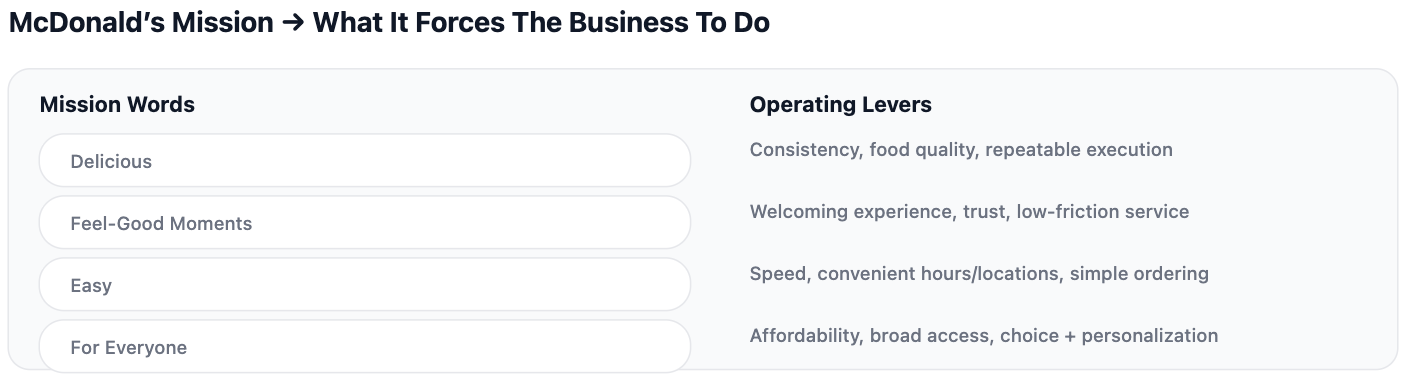
Here’s how I break the line down when I want it to guide real choices:
-
“Delicious” = food has to taste good, consistently, at massive volume.
-
“Feel-good moments” = the customer should leave feeling satisfied, not stressed.
-
“Easy” = convenience is part of the product, not a bonus.
-
“For everyone” = broad accessibility, not an elite niche.
McDonald’s corporate mission page also explains the “how” behind that promise: convenient locations and hours, affordable prices, and a focus on speed, choice, and personalization—plus a welcoming, dependable personality.
When I see those details, I do not treat the mission as a slogan. I treat it as an operating system.
What Does McDonald’s Mission Statement Mean?
McDonald’s mission means it wants to deliver tasty food + a positive emotional outcome + convenience at scale.
If I translate it into plain business logic, I get this: McDonald’s is not only selling food. McDonald’s is selling a reliable moment that fits into real life. That is why the mission includes “easy” and “for everyone.” It is a commitment to availability and affordability, not just flavor.
This is also where I like using the same “Three-Voices” lens I use on voicesfromtheblogs.com:
-
Market voice: customers expect speed, value, and consistency in quick service.
-
People voice: customers want comfort, familiarity, and a low-stress experience.
-
Strategist voice: the company must build systems that deliver speed, choice, and personalization without breaking the brand promise.
When I see it that way, the mission becomes a filter for tradeoffs. If an idea adds complexity, slows service, or raises price beyond “everyone,” it fights the mission. If an idea improves ease and feel-good moments while keeping quality stable, it supports the mission.
How Does McDonald’s Put The Mission Into Practice?
McDonald’s puts the mission into practice by designing for convenience, affordability, and the speed/choice/personalization customers expect.
I do not need insider info to see the pattern. The mission basically demands operational excellence. It demands repeatable service, not occasional greatness. So when I look for mission alignment, I look for what makes the customer’s life easier and what protects the “feel-good” part.
How Does “Easy” Show Up In The Business?
“Easy” shows up through friction removal in ordering, pickup, and time-to-food.
If I am honest, “easy” is the hardest promise to keep at scale. It requires process design. It requires layouts, staffing models, and reliable execution. The mission page signals this directly by calling out speed and convenience.
When I apply this lesson to my own projects, I ask: what is the “easy” in my experience? For a website tool, “easy” might mean one input, one output, no setup. That is also the logic behind VOICES Intelligence Engine: one question in, one mini business report out, in plain English.
How Does “Feel-Good Moments” Show Up In The Business?
“Feel-good moments” shows up through a welcoming tone and dependable experience, not just product features.
McDonald’s explicitly ties the mission to a lighthearted, welcoming, dependable personality.
That matters because emotion is part of value. Customers do not only remember taste. Customers remember how the experience felt. If the experience feels rushed, confusing, or inconsistent, the “moment” stops being feel-good. This is a useful reminder for any brand: emotion is operational. It lives in wait times, clarity, and how problems get handled.
How Does “For Everyone” Show Up In The Business?
“For everyone” shows up through affordability and broad access, supported by convenient locations and hours.
This is the part many mission statements avoid, because it forces hard decisions. “For everyone” means the brand cannot drift too far into premium-only thinking. It must protect access. It must protect value perception. It must keep choice wide enough that more people can find a fit. The mission page makes that intent explicit through affordability, convenience, and choice/personalization.
Why Might You See Different McDonald’s Mission Statements Online?
You might see different wording because some regional sites and older FAQs use older “aim” language, while the corporate mission page shows the current mission.
If someone googles quickly, they may land on an older country FAQ that describes a different “aim” (for example, McDonald’s UK has a 2018 FAQ with different wording).
So if you want the cleanest, current corporate phrasing, I stick with the official corporate mission and values page. What Can I Learn From McDonald’s Mission Statement?
I can learn to write a mission that includes an outcome, an experience promise, and a scale promise.
McDonald’s mission is short, but it is not vague. It names a result (“delicious”), a feeling (“feel-good moments”), a delivery standard (“easy”), and an audience scope (“everyone”). That structure is worth copying.
Here’s a mission template I use that follows the same logic:
(1) We make [core outcome]
(2) feel [emotional result]
(3) by keeping it [delivery standard]
(4) for [who it’s for].
Then I test it with one hard question: What would we stop doing if we took this mission seriously? If I cannot name a “no,” the mission is not sharp enough.
Conclusion
McDonald’s mission promises delicious, feel-good moments made easy for everyone—and the real power is how that promise forces operational choices.