
What Is Starbucks’ Mission Statement?
A brand can feel “everywhere,” yet people still ask what it truly stands for.
Starbucks’ mission statement is: “To be the premier purveyor of the finest coffee in the world, inspiring and nurturing the human spirit — one person, one cup and one neighborhood at a time.”
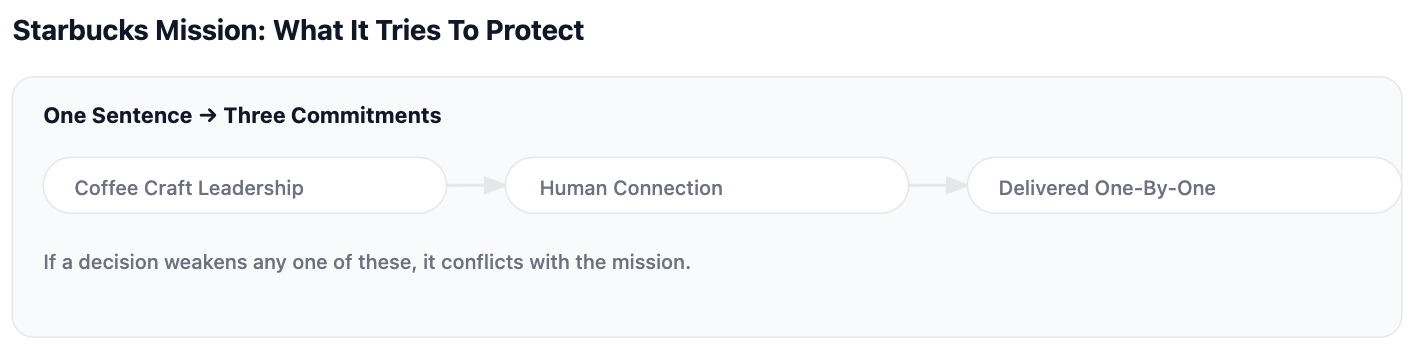
That line is not just a quote. I use it as a practical lens to understand what Starbucks wants to protect: coffee craft + human connection + local scale.
What Is Starbucks’ Mission Statement?
Starbucks’ current mission statement is the full “premier purveyor…human spirit” line shown on its official mission page.
What matters is the structure. The mission has two big promises inside one sentence:
-
Coffee leadership (“premier purveyor of the finest coffee…”)
-
Human connection (“inspiring and nurturing the human spirit…”)
-
Scale of delivery (“one person, one cup and one neighborhood…”)
Starbucks also publicly framed this updated wording as part of getting “Back to Starbucks,” which signals a return to coffeehouse identity and handcrafted coffee.
What Does Starbucks’ Mission Statement Mean?
Starbucks’ mission means the brand wants to win on coffee quality while staying emotionally human at the point of service.
I read it like this: Starbucks is not saying “we sell coffee.” Starbucks is saying “we deliver coffee as a connection ritual.” The “one person, one cup, one neighborhood” phrase is a guardrail against scale turning the experience cold. It suggests that even if the company is global, it wants each interaction to feel personal.
When I map that to real behavior, I look for the mission’s fingerprints:
-
In-store experience: barista craft, consistency, speed balanced with warmth
-
Product decisions: drinks and food that support coffeehouse identity
-
Community posture: the store as a gathering space, not just a transaction window
On voicesfromtheblogs.com, I usually frame things as signals: Market, People, Strategist. Starbucks’ mission tries to balance all three. The market wants efficiency and expansion. People want comfort and identity. Strategy tries to protect the “coffeehouse” meaning while scaling.
Did Starbucks Change Its Mission Statement?
Yes—Starbucks has described updating its mission statement, while keeping the human-connection core.
The mission page shows the longer version that includes “premier purveyor of the finest coffee in the world…”
At the same time, some regional pages still show the shorter “inspire and nurture the human spirit…” line without the “premier purveyor” clause (for example, Starbucks Singapore’s about-us page).
Practically, I treat this as one mission with two common presentations:
-
Full framing: coffee leadership + human spirit + one-by-one scale
-
Short framing: human spirit + one-by-one scale
If you’re writing about it, I’d quote the version that matches the market/site context you’re referencing.
How Do I Use Starbucks’ Mission Statement As A Business Lesson?
I use Starbucks’ mission as a checklist: promise one craft standard, one emotional standard, and one delivery standard. When I write mission statements for my own projects, I copy the shape (not the words). Starbucks doesn’t only say what it sells. It says what it protects. That is the part most mission statements miss.
How Do I Turn A Mission Into Decisions?
I turn a mission into decisions by translating it into “yes/no” filters.
Here’s a simple set inspired by Starbucks’ structure:
(1) Craft filter: Does this improve the core product quality?
(2) People filter: Does this make the experience more human and trusted?
(3) Scale filter: Can we deliver it consistently, one customer at a time?
If a plan fails one filter, I either redesign the plan or I admit it is not mission-aligned. This is how a mission becomes more than wall art.
How Do I Avoid The “Generic Mission” Trap?
I avoid generic missions by using nouns that force specificity.
Starbucks uses concrete nouns like coffee, cup, and neighborhood.
That matters because concrete nouns create operational responsibility. If I write “We empower people,” I can’t measure it. If I write “We deliver clear insights in plain English in one report,” I can measure that. This is also why the voicesfromtheblogs.com positioning works: it promises a specific output (a mini business report) and a specific translation method (Three-Voices).
Conclusion
Starbucks’ mission blends coffee craft with human connection, delivered one customer at a time.