
What Is A Mission?
A team can stay busy for months, then realize nobody aimed at the same target.
A mission is the clear purpose an organization acts on: who it serves, what it does, and why it exists right now. I use mission to keep decisions consistent when priorities compete.
I treat mission like a “north line,” not a motivational quote.
What Is A Mission?
A mission is the practical reason an organization exists today and what it commits to do for a specific group of people. It is about the present. It explains how the organization shows up in the world right now. If vision is “where we are going,” mission is “what we do every day to move there.” When I understand a company’s mission, I can usually predict what work gets funded, what metrics matter, and what the culture rewards. That is why mission matters beyond branding. It becomes an operating tool.
I like a mission because it reduces noise. On voicesfromtheblogs.com, the whole point is decoding messy market voices into the Three-Voices Framework—Market, People, Strategist. Mission belongs in the Strategist voice. It takes the market reality and customer needs, then states what the organization will do about it.
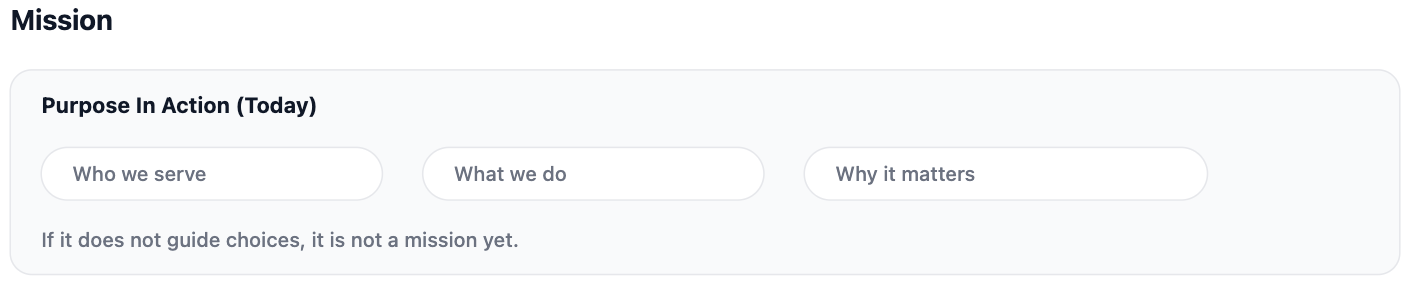
I keep mission simple with three parts:
(1) Who we serve
(2) What we do
(3) Why it matters
If any part is missing, the mission often becomes vague or self-focused.
What Does Mission Mean In Business?
In business, mission means the operating purpose that shapes strategy, priorities, and behavior. It is not only for external audiences. Internally, mission helps me answer: “What should we focus on?” If a company’s mission is to make financial planning simpler for everyday people, then product decisions should reduce complexity, support trust, and improve accessibility. If the company’s mission is to deliver premium performance for professionals, then decisions should protect quality, reliability, and support.
I use mission as a filter for tradeoffs:
(1) Scope: do we expand to a new segment or deepen value for our core users?
(2) Quality vs speed: what is acceptable given our promise?
(3) Pricing: do we optimize for access or premium positioning?
(4) Hiring: what roles matter most to deliver the mission?
(5) Marketing tone: what story matches the mission and feels believable?
Mission becomes real when it changes answers to these questions.
Why Does A Mission Matter?
A mission matters because it aligns people, reduces waste, and makes priorities easier to defend. When I do not have a shared mission, teams tend to optimize locally. Marketing chases impressions, product chases features, sales chases any deal, and support fights fires. A mission gives a shared “why” that connects these functions. It also builds consistency. Customers feel consistency as trust.
I also think mission matters because it creates boundaries. Without boundaries, everything becomes “strategic,” and then nothing is. When a mission is clear, saying “no” feels less personal. It becomes: “That is not our mission.”
What Is The Difference Between Mission, Vision, And Values?
Mission is what we do now, vision is where we want to go, and values are how we behave while doing it. I keep this distinction simple because teams often mix them up.
(1) Mission: present-focused, action-focused purpose
(2) Vision: future-focused direction and destination
(3) Values: behavior standards and decision principles
If I write a mission that sounds like a vision (“to be the world’s leading…”) I lose clarity. If I write values inside the mission (“we believe in integrity…”) the mission becomes crowded.
What Makes A Good Mission?
A good mission is specific, customer-centered, and easy to use in decisions. I like missions that a team can repeat and apply.
A strong mission usually has:
(1) a clear customer group
(2) a clear deliverable (product/service category)
(3) a clear impact (outcome)
(4) language that is plain and memorable
(5) implied priorities (what the company will not do)
If the mission could fit a bank, a shoe brand, and a charity with no edits, it is too generic.
How Do I Turn A Mission Into Action?
I turn a mission into action by connecting it to metrics, priorities, and daily behaviors. A mission is not useful if it stays in a slide deck.
I do this in a simple sequence:
(1) Choose 1–3 mission metrics: what proves progress?
(2) Set quarterly priorities: what work moves those metrics?
(3) Define “no” rules: what we stop doing to protect focus
(4) Train managers: how to use mission in tradeoffs
(5) Audit touchpoints: does the customer experience match the mission?
This is basically “mission as an operating system.”
What Are Common Mission Mistakes?
Common mission mistakes are being vague, being self-focused, and writing for inspiration instead of decisions. I avoid:
(1) abstract verbs like “empower” with no real deliverable
(2) “everyone” as the customer
(3) mission statements that promise outcomes the business cannot control
(4) mixing mission with vision and values in one sentence
(5) not connecting mission to metrics and priorities
If I fix these, mission becomes a tool people actually use.
Conclusion
A mission is purpose in action today, defining who I serve, what I do, and why it matters.