
What Is A Value Statement?
My offer can be solid, yet people still hesitate, because they cannot explain the value in one sentence.
A value statement is a short, clear sentence that states who an offer is for, what benefit it delivers, and why it is worth choosing. I use it to remove confusion and make the “why buy” obvious.
I treat a value statement as the simplest version of my positioning.
What Is A Value Statement?
A value statement is a concise message that explains the core value an offer delivers to a specific customer. It is not a slogan and not a generic brand line. A slogan can be emotional and vague. A value statement should be practical and specific. It should help a buyer understand fit fast. When I write a value statement well, I can reuse it across a homepage hero, ad copy, a sales intro, and a product one-liner. When I write it poorly, everything becomes long and wordy because I keep trying to “explain” the offer instead of stating the value.
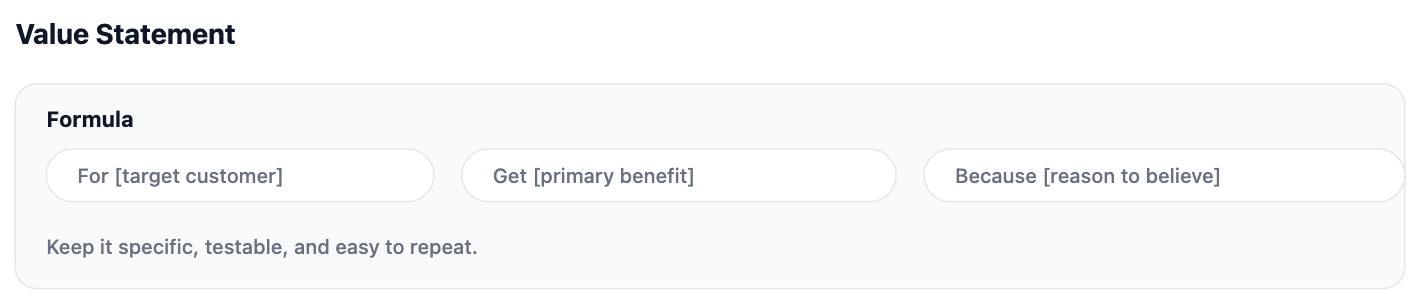
I keep a value statement grounded in three parts:
(1) Target customer: who this is for
(2) Primary benefit: what outcome they get
(3) Reason to believe: why this is credible or different
This also fits the voicesfromtheblogs.com style. The site is built to decode the hidden “voices” behind a market question and translate them into a clear, plain-English output. A value statement is exactly that type of output: one line that turns noise into clarity.
Why Is A Value Statement Important?
A value statement is important because it improves clarity, conversion, and consistency across channels. Buyers do not want homework. They want a fast answer: “Is this for me, and is it worth it?” A value statement helps me answer that in one breath. It also improves internal alignment. When teams cannot describe value the same way, marketing copy becomes inconsistent and sales calls drift into feature lists. A value statement becomes a shared anchor.
Here is what usually improves when I have a strong value statement:
(1) Homepage performance: visitors understand the offer faster
(2) Ad efficiency: I can write shorter ads that still convert
(3) Sales enablement: reps stop improvising the story
(4) Product focus: teams build toward the promised benefit
(5) Retention: customers buy with the right expectations
The value statement is not the whole strategy, but it makes the strategy easier to express.
How Do I Write A Value Statement?
I write a value statement by choosing a specific customer, one main benefit, and one credible reason to believe. I keep it short enough to say out loud.
Step 1: Choose The Exact Customer
I pick a specific customer segment, not “everyone.” If I try to speak to everyone, I sound like nothing. I use a simple format: role + context. Example: “For first-time founders launching a subscription product.” That is already more actionable than “for businesses.”
Step 2: Pick One Primary Benefit
I choose one benefit that matters most and can be felt quickly. I avoid listing five benefits. If everything is the benefit, nothing is the benefit. I pick the main job: save time, reduce risk, increase revenue, improve accuracy, or simplify a workflow. I also try to make it concrete: “reduce planning from hours to minutes” is stronger than “improve productivity.”
Step 3: Add A Reason To Believe
I add a reason to believe that is real and hard to fake. This is where many value statements become fluff. “Because we are innovative” is weak. Better reasons include:
(1) a method or framework
(2) a specific capability or workflow
(3) a proof asset like results or examples
(4) a guarantee or policy that reduces risk
(5) a niche focus that fits better than general tools
I keep the reason short, because I can expand proof elsewhere on the page.
Step 4: Make It Sound Like Human English
I rewrite the statement until it sounds like something a real person would say. If it sounds like corporate language, it will not stick. I remove filler words and buzzwords. I keep the sentence structure simple.
Step 5: Test It Against Objections
I test the value statement by asking what a skeptical buyer would say next. If the next question is “What do you mean?” the statement is too vague. If the next question is “Can you prove it?” I add proof nearby. If the next question is “Is this for me?” I tighten the segment.
What Are Examples Of Value Statements?
Good value statements are specific, customer-centered, and easy to repeat. Here are patterns I use (as templates, not final copy):
(1) “For [segment], [product] helps you [outcome] without [pain], so you can [bigger win].”
(2) “For [role], [product] delivers [benefit] in [timeframe] by [how], compared to [alternative].”
(3) “For [customer], [offer] reduces [risk/cost] and improves [result] because [proof].”
I keep examples short because the real power is in the inputs: segment, benefit, proof.
What Is The Difference Between A Value Statement And A Mission Statement?
A value statement explains what customers get; a mission statement explains why the company exists. A mission statement can be broad and aspirational. A value statement must be practical and buyer-focused.
(1) Mission: “We exist to…”
(2) Value statement: “Customers get…”
Both matter, but they solve different problems. When I need conversion clarity, I reach for a value statement.
What Are Common Value Statement Mistakes?
Common mistakes are being vague, listing features, and skipping proof. I avoid:
(1) “We provide solutions” language
(2) too many benefits in one sentence
(3) customer segments that are too broad
(4) “because we care” reasons-to-believe
(5) statements that cannot be backed up by the product experience
When I fix these, the message becomes shorter and stronger.
Conclusion
A value statement is a one-line promise of benefit for a specific customer, with a clear reason to believe.