
What Is Customer Value?
A product can be “good,” yet customers still do not buy, because the value is not clear to them.
Customer value is the benefit a customer believes they receive compared to what they give up, like money, time, effort, and risk. I focus on it because it explains why people choose, stay, or leave.
I treat customer value as the real driver behind pricing, positioning, and retention.
What Is Customer Value?
Customer value is the customer’s perceived tradeoff between gains and costs. The key word is “perceived.” Value is not what I think I deliver. Value is what the customer believes they get, in their context, at that moment. Two customers can use the same product and feel very different value. One customer feels relief because the product removes a painful step. Another customer feels little value because the pain was not urgent. That is why I always connect value to a specific job-to-be-done and a specific situation. When I do not, my messaging becomes generic, and customers default to comparing price.
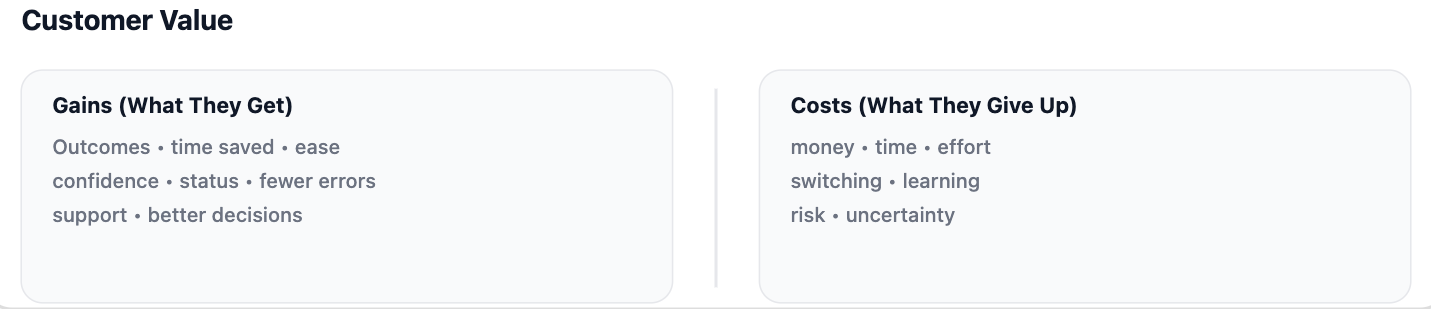
I break customer value into a simple mental formula:
(1) Gains: outcomes, convenience, status, confidence, saved time
(2) Costs: price, switching effort, learning time, risk of failure, uncertainty
In practice, value rises if gains increase or if costs decrease. Many teams only try to increase gains by adding features. I often find a faster move is lowering costs: reducing setup, reducing risk, reducing confusion.
This is also why the voicesfromtheblogs.com lens matters. The “People voice” is customer sentiment and choice behavior. The “Market voice” is what alternatives exist and what they cost. Then the “Strategist voice” is how I change the offer so the value tradeoff becomes obvious.
Why Is Customer Value Important?
Customer value is important because it drives purchase decisions, willingness to pay, and retention. If customers do not see value, they do not buy. If they see weak value, they buy only with discounts. If they see strong value, they buy faster and stay longer. This is why I treat customer value as a strategy input, not only a marketing concept.
Customer value affects:
(1) Conversion: buyers choose the offer that feels most worth it
(2) Pricing: value sets the ceiling for what customers will pay
(3) Churn: customers leave when perceived value drops below cost
(4) Referrals: customers recommend when value feels obvious and shareable
(5) Competitive positioning: value is the “reason to choose” in real words
I also see value as a way to reduce internal debates. Instead of arguing about features, I ask: “Does this increase gains or reduce costs for the customer?” If not, it is probably not priority work.
What Are Examples Of Customer Value?
Customer value shows up as a clear improvement in outcomes or a clear reduction in costs and risk. I like examples that map to real behavior.
Outcome Value
Outcome value is when the customer gets a better result. A tool that increases sales conversion, improves accuracy, or raises output quality can create outcome value. The key is that the customer believes the outcome is real and repeatable.
Convenience Value
Convenience value is when the customer saves time or effort. Removing steps, automating repetitive work, or making decisions faster can create strong value. Convenience often wins when the market is crowded, because many products are “good enough,” but fewer products feel easy.
Risk-Reduction Value
Risk-reduction value is when the customer feels safer. Guarantees, compliance support, predictable performance, and clear onboarding can reduce fear. In many B2B purchases, risk reduction is the main value driver.
Emotional And Identity Value
Emotional value is how the customer feels when using or owning the product. This includes confidence, status, belonging, and pride. Even in “rational” markets, emotional value matters because it shapes trust and comfort.
How Do I Measure Customer Value?
I measure customer value by combining customer feedback with behavior signals. I do not rely only on surveys, because people often say one thing and do another.
The signals I use most:
(1) Willingness to pay: do customers accept the price without heavy discounting
(2) Retention and repeat use: do customers keep using it over time
(3) Expansion: do customers buy more, upgrade, or add seats
(4) Referral rate: do customers recommend it
(5) Objections: what stops customers from buying
(6) Time-to-value: how fast customers get their first meaningful result
If value is strong, time-to-value is usually shorter, and objections shift from “I don’t get it” to “I need internal approval.”
How Do I Increase Customer Value?
I increase customer value by raising the most important gains or lowering the biggest costs in the customer’s decision. I keep it focused.
Increase The Right Gains
I focus on one or two gains that matter most to the target segment. I avoid adding features that do not change outcomes. I strengthen the “main job” the customer is hiring the product to do.
Reduce Customer Costs
I reduce costs by making the product easier and safer to adopt. I simplify setup, reduce learning time, improve onboarding, and remove friction. I also reduce hidden costs like unclear pricing and unclear policies.
Add Proof That Matches The Customer’s Fear
I add proof that makes value believable. If customers fear wasting time, I show time saved. If customers fear switching, I show a migration path. If customers fear risk, I show guarantees and case results.
Improve Consistency
I increase value by delivering the same good experience repeatedly. Value drops when experiences are inconsistent. One great week cannot compensate for three frustrating weeks.
What Are Common Customer Value Mistakes?
Common mistakes are assuming value is obvious, over-focusing on features, and ignoring switching costs. I avoid:
(1) explaining the product instead of the outcome
(2) using generic benefits like “save time” without proof
(3) ignoring the customer’s existing alternative
(4) underestimating setup and change effort
(5) pricing without anchoring value
When I fix these, customers buy with less hesitation and stay with more confidence.
Conclusion
Customer value is the perceived benefit customers get versus what they give up, and it improves when gains rise or costs fall.