
What Is A Brand Promise?
A brand can look polished, yet people still hesitate, because they do not know what the brand will deliver for them.
A brand promise is the clear commitment a brand makes about the experience or outcome customers can expect. I treat it like a contract in plain English.
If the promise is unclear or broken, trust drops fast. If the promise is clear and consistent, growth gets easier.
What Is A Brand Promise?
A brand promise is the specific value or experience I commit to deliver every time a customer interacts with my brand. It is not a tagline, and it is not a mission statement. A promise is about the customer’s outcome. It tells customers what they can count on. Some brands promise speed. Some promise safety. Some promise simplicity. Some promise premium quality. The key is that the promise must be real. If the brand promise is not supported by the product, service, and policies, it becomes empty words.
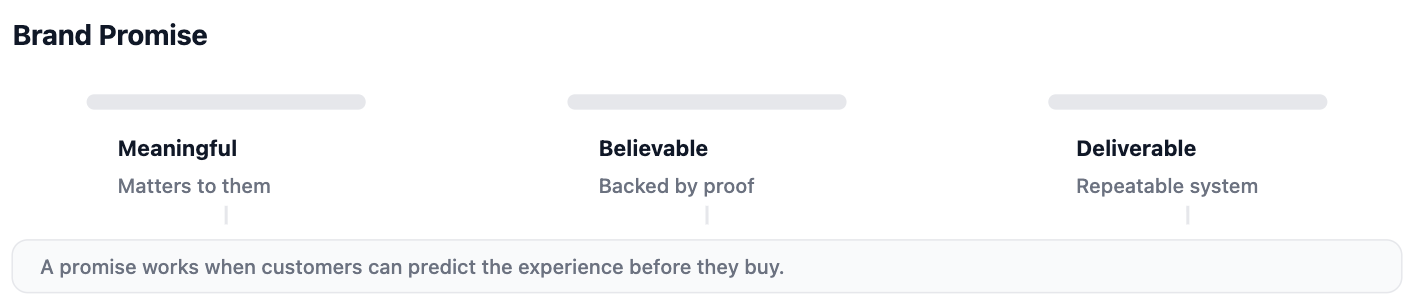
I keep a brand promise practical by checking three things:
(1) Is it meaningful to the customer?
(2) Is it believable with proof?
(3) Can the business deliver it consistently?
When those three align, the promise becomes a strong anchor for messaging, product decisions, and customer experience.
Why Does A Brand Promise Matter?
A brand promise matters because it builds trust, sets expectations, and reduces decision friction. Customers always wonder what will happen after they pay. A clear promise reduces that uncertainty. It also helps the business stay consistent. When teams disagree on what they are delivering, customers feel it. One email sounds premium, the support experience feels rushed, and the product onboarding feels confusing. A brand promise becomes the “one standard” that guides those experiences.
Here is what a strong brand promise improves:
(1) Conversion: customers understand what they get
(2) Retention: customers get the expected value
(3) Word-of-mouth: customers can describe the brand simply
(4) Pricing power: customers pay more when trust is high
(5) Focus: teams stop adding random features and messages
This also fits naturally with how I think on voicesfromtheblogs.com. When I try to decode a market question, I want a clear output that guides action. A brand promise is a similar output: one clear expectation that guides decisions.
What Is The Difference Between A Brand Promise And A Value Proposition?
A value proposition explains why I am worth choosing; a brand promise commits to what I will deliver consistently. They overlap, but they are not the same.
(1) Value proposition: “Here is the benefit and why it is worth it.”
(2) Brand promise: “Here is what you can count on every time.”
A value proposition can be more specific to an offer or campaign. A brand promise is the stable core that should not change every month.
What Makes A Strong Brand Promise?
A strong brand promise is specific, customer-centered, and supported by proof and operations. I avoid promises that are so broad they mean nothing.
Specific And Concrete
A promise works best when it points to a real outcome or experience. “We provide excellent service” is too vague. “We respond within 2 hours” is clearer. Even if the promise is not a number, it should be concrete, like “simple setup” or “no surprises pricing.” Specific promises are easier to deliver.
Focused On The Customer
A brand promise should describe the customer’s outcome, not the company’s personality. Customers do not buy “we are innovative.” They buy what innovation does for them.
Supported By Proof
A promise needs proof so it feels believable. Proof can be examples, guarantees, case studies, transparent policies, or consistent reviews. Without proof, the promise becomes a claim, and claims are cheap.
Supported By Systems
A promise must be supported by operations and product reality. If I promise speed, I need processes that produce speed. If I promise premium quality, I need quality control and support that match. This is the part many brands ignore. A promise is not only marketing. It is a business system.
How Do I Write A Brand Promise?
I write a brand promise by choosing one core expectation I can deliver and framing it in simple language. I keep it short enough to remember.
Step 1: Identify The Real Reason Customers Choose You
I start by looking at why customers already choose us. I use interviews, reviews, and sales notes. I look for repeated phrases like “so easy,” “finally reliable,” “felt premium,” or “support actually helped.” Those repeats are the best promise candidates because they are already true in the market.
Step 2: Choose One Primary Promise
I choose one primary promise so the brand has one clear center of gravity. The business can deliver many things, but the promise should be the main thing customers remember. If I try to promise everything, I sound generic.
Step 3: Write It In Plain English
I write the promise in a simple sentence that a customer would understand instantly. I avoid jargon and internal language. I also avoid exaggeration. A promise that is slightly conservative but consistently true builds more trust than a bold promise that breaks.
Step 4: Attach Proof And Behaviors
I attach proof and behaviors so teams can deliver it consistently. I list:
(1) what the customer should see that proves the promise
(2) what employees must do to deliver it
(3) what policies protect it (refunds, service standards, guarantees)
If I cannot attach proof and behaviors, the promise is not ready.
Step 5: Check For Break Points
I check where the promise could break across the customer journey. If my promise is “simple,” I test onboarding, pricing clarity, and support steps. If my promise is “fast,” I test response time and delivery time. This keeps the promise real.
What Are Common Brand Promise Mistakes?
The most common mistakes are vague promises, copying competitors, and making promises the business cannot sustain. I avoid:
(1) promises like “best quality” without a definition
(2) promises that sound identical to every competitor
(3) promises that require perfect execution every time
(4) promises that marketing states but operations cannot support
(5) promises that are not tested against real customer experience
A broken promise damages trust faster than no promise at all.
Conclusion
A brand promise is the clear outcome I commit to deliver consistently, so customers know what to expect and trust the brand.